Introduction
AI is transforming how we create and consume content. After ChatGPT revolutionized text-based AI, OpenAI’s Sora 2 does the same for video. Launched in 2025, Sora 2 is not just an upgrade to the original Sora model; it’s a leap forward in AI-driven video generation, offering physics-aware environments, realistic motion, multi-scene continuity, and advanced audio syncing.
For USA readers, whether you’re a content creator, filmmaker, educator, or tech enthusiast, Sora 2 opens exciting opportunities. However, the following questions remain: What exactly is Sora 2? How can you access it in the USA? And how does it compare with Google’s Veo 3, another powerful AI video model?
This article gives you a complete guide to Sora 2, its features, accessibility, pricing, and comparisons, so you can decide if it’s the right tool for your creative projects.
What is Sora 2?
Sora 2 is OpenAI’s second-generation AI video model, officially launched in September 2025. Unlike the first Sora (released in early 2024), which introduced AI-generated video concepts, Sora 2 takes a significant leap by:
- Generating ultra-realistic, cinematic videos up to several minutes long.
- Ensuring physics consistency (objects move naturally and follow real-world rules).
- Supporting multi-character interactions across different scenes.
- Adding built-in voice, dialogue, and sound effects.
- Offering social media integration (a TikTok-like app for sharing AI videos).
In short, Sora 2 is like ChatGPT for video, but with advanced editing and storytelling powers.
Key Features of Sora 2 (2025 Update)
Here are the top features that make Sora 2 stand out:
- Physics-Aware Simulation
- Videos follow natural rules like gravity, lighting, and motion blur.
- Example: A basketball bounces realistically instead of floating unnaturally.
- Character Consistency
- Unlike older AI video models, characters remain the same across scenes.
- Example: If you create a character in Scene 1, they look and act the same in Scene 5.
- Multi-Scene Storytelling
- Generate complete short films instead of short random clips.
- Perfect for filmmakers, YouTubers, and educators.
- AI Audio Sync
- Sora 2 generates voices, dialogues, and background music aligned with the video.
- Social Integration (Sora App)
- A TikTok-like app launched with Sora 2, where all videos are 100% AI-generated.
- Users can remix, collaborate, and share their Sora creations instantly.
How to Access Sora 2 in the USA
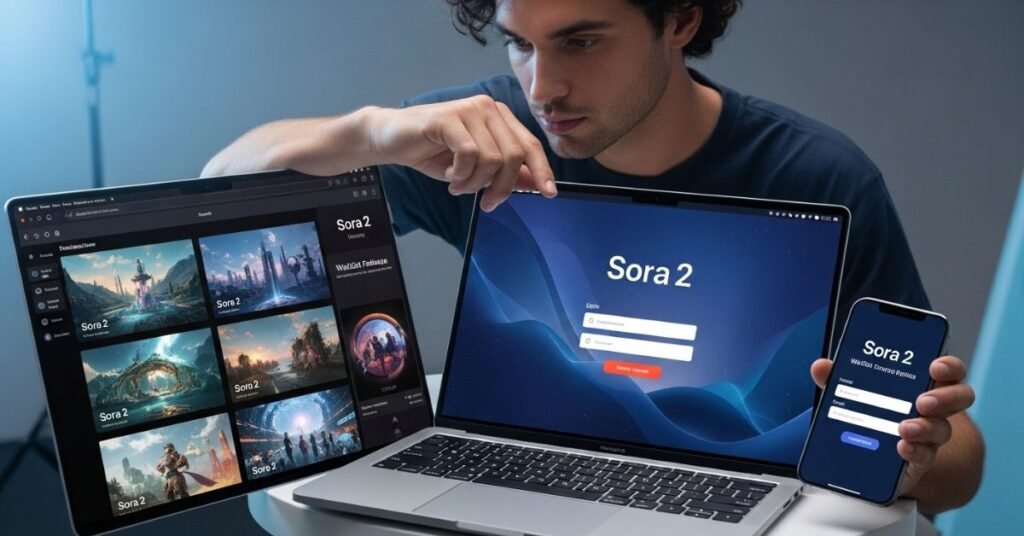
Sora 2 is not open to everyone; it’s available in stages. Here’s a step-by-step guide for USA users:
Step 1: Join the Waitlist
- Visit the official OpenAI Sora 2 page.
- Click on “Join Waitlist” to apply for early access.
- Provide your email and professional details (creators, educators, and researchers are prioritized).
Step 2: Beta Access
- Early access is being rolled out to USA-based creators, filmmakers, and educators.
- Selected users get an invitation email with login credentials.
Step 3: Download or Use via Web
- Web App Access: Sora 2 is available via browser on desktop/laptop.
- Mobile App (2025): OpenAI confirmed iOS and Android apps are coming soon.
Step 4: Subscription Plans (Expected)
- Free Tier: Limited video length, watermarked outputs.
- Pro Plan: Monthly subscription with HD export and longer videos.
- Enterprise Plan: For studios & production houses.
Note: Official pricing hasn’t yet been fully disclosed (as of Oct 2025), but reports suggest a subscription model that is $20–$50/month, similar to ChatGPT Plus.
If you’re exploring advanced tools that boost creativity and productivity, you might also want to check out our detailed guide on the Logitech MX Master 4.
This mouse, launched in the USA recently, is designed for professionals who want seamless workflow efficiency. While Sora 2 transforms video generation through AI, the Logitech MX Master 4 enhances your hands-on productivity together; they show how hardware and AI software are shaping the future of work.
Sora 2 Video Generation Examples
Examples bring the magic to life. Here are some ideas you might try:
- “A fox running through autumn woods in slow motion with gentle wind sounds.”
- “A futuristic New York skyline at sunset, flying cars, neon lights.”
- “A child laughing and blowing bubbles on a summer evening.”
- “A cinematic product reveal: smartphone rotating on reflective surface.”
These Sora 2 video generation examples show how varied scenes can be created from nature to tech to storytelling.
Sora 2 for Beginners Guide
If you’re new to AI video tools, don’t worry. Sora 2 is designed for beginners:
- Start Small – Use simple prompts like “dog playing in the park.”
- Explore Styles – Try cinematic, animation, or documentary mode.
- Experiment with Length – Begin with 10-second clips before making longer videos.
- Leverage Templates – Use OpenAI’s pre-built templates to save time.
Sora 2 vs Google Veo 3 – Which is Better?
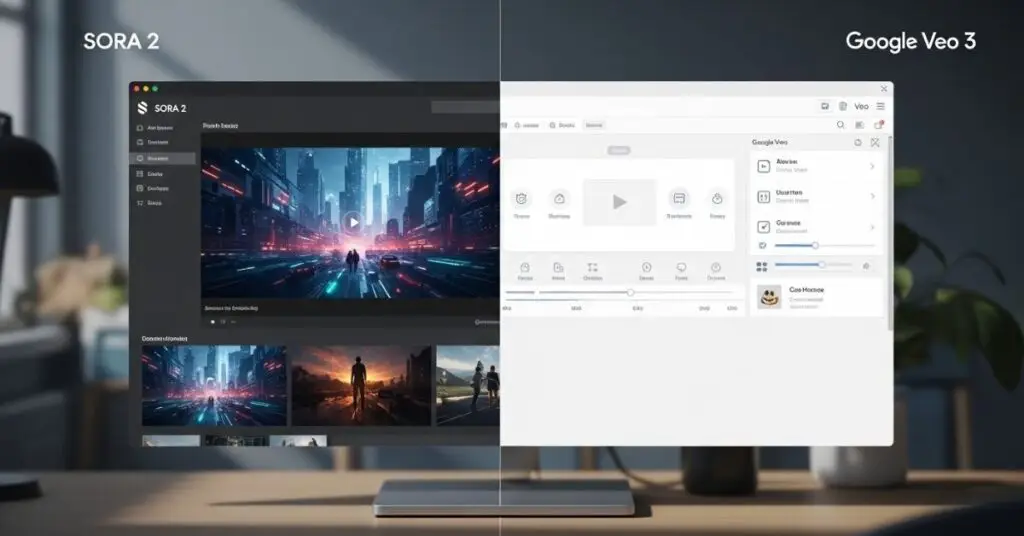
In 2025, OpenAI’s Sora 2 and Google DeepMind’s Veo 3 lead the AI video race. Let’s compare them:
| Feature | Sora 2 (OpenAI) | Veo 3 (Google) |
|---|---|---|
| Launch Date | Sept 2025 | May 2025 (I/O event) |
| Video Quality | Cinematic, physics-aware | Ultra-HD, realistic lighting |
| Length | Multi-minute storytelling | 1–2 minutes (higher fidelity) |
| Audio | Built-in voices, dialogues, sound effects | No native audio (must add separately) |
| Integration | Sora App (TikTok-like) | Integrated with YouTube Shorts |
| User Access | Waitlist + Web App | Restricted to select creators (beta) |
| Best For | Filmmakers, storytellers, social media | Professional editors, YouTubers |
Key Insight:
- Sora 2 is better for casual creators and storytellers (because of audio + app).
- Veo 3 is better for professional cinematic quality (but harder to access).
Sora 2 vs Sora 1 Differences
Sora 2 is not just an update, it’s a complete evolution:
| Feature | Sora 1 | Sora 2 |
|---|---|---|
| Resolution | 720p | 1080p–4K |
| Physics | Limited | Realistic motion |
| Characters | Reset each scene | Consistent across clips |
| Sound | None | Voices + sound effects |
| Access | Limited demo | Beta + App Integration |
Verdict: Sora 2 is leagues ahead of Sora 1 for real-world creators.
Who Should Use Sora 2 in the USA?
Sora 2 is designed for a wide range of audiences:
- Filmmakers & Storytellers – Create short films, ads, or story-driven content.
- YouTubers & TikTokers – Generate viral, AI-powered clips in seconds.
- Educators – Turn lesson plans into animated explainer videos.
- Businesses & Marketers – Produce ads, product demos, and branded content.
- AI Enthusiasts – Experiment with the future of generative video AI.
In the USA, many creators compare Sora 2 with Runway Gen-3, another leading AI video tool.
| Aspect | Sora 2 | Runway Gen-3 |
|---|---|---|
| Visual Realism | More cinematic | Strong, but less physics-based |
| Character Consistency | High | Moderate |
| Audio Support | Yes | Limited |
| Editing Tools | Advanced | Basic |
| Access | Waitlist (USA priority) | Subscription-based |
Sora 2 provides more advanced storytelling features for filmmakers and professionals, while Runway Gen-3 may appeal to casual creators due to easier access.
Limitations of Sora 2 (What You Should Know)
While Sora 2 is groundbreaking, it’s not perfect:
- Access is Limited – USA users still need invitations or approval from the waitlist.
- Occasional Artifacts – Videos may sometimes glitch (e.g., distorted objects).
- Ethical Concerns – Deepfake misuse and copyright issues remain a debate.
- Subscription Cost – Likely not free for professional use.
Future of AI Video (Sora 2 and Beyond)
OpenAI confirmed that Sora 3 is already in research, with better realism, 3D video support, and interactive VR/AR possibilities.
This means:
- Creators could soon “direct movies” using only text prompts.
- Social media will flood with AI-generated entertainment.
- The USA entertainment industry (Hollywood, YouTube, TikTok) will heavily integrate these tools.
Limitations of Sora 2 (What You Should Know)
While Sora 2 is groundbreaking, it’s not perfect:
- Access is Limited – USA users still need invitations or approval from the waitlist.
- Occasional Artifacts – Videos may sometimes glitch (e.g., distorted objects).
- Ethical Concerns – Deepfake misuse and copyright issues remain a debate.
- Subscription Cost – Likely not free for professional use.
Conclusion
Sora 2 is OpenAI’s bold step into the future of AI-generated video. Its physics-aware realism, character consistency, built-in audio, and TikTok-style social app make AI video creation accessible to everyday creators in the USA.
Compared to Google’s Veo 3, Sora 2 focuses more on storytelling and usability, while Veo 3 pushes the limits of ultra-HD realism for professionals.
For USA readers, the best way to start is by joining the Sora 2 waitlist today and exploring its creative possibilities once access is granted. The future of video is not just recorded, it’s generated. And with Sora 2, you’re one step closer to directing your AI-powered film.
FAQs about Sora 2
Q1: What is Sora 2 OpenAI?
Answer: Sora 2 by OpenAI is a next-generation AI video model that turns text prompts into realistic short films with sound, dialogue, and scene consistency. Unlike the first Sora, this version understands physics, emotions, and continuity, making it a powerful tool for creators in the USA and Canada.
Q2: How does Sora 2 work?
Answer: Sora 2 works by combining diffusion models and transformers. You type a prompt like “a dog running in Times Square” and it generates smooth, cinematic clips with realistic movement, lighting, and even audio. It’s like having a virtual film crew powered entirely by AI.
Q3: How do you access Sora 2 in the USA?
Answer: To access Sora 2 in the USA, sign up for OpenAI’s waitlist or beta program. Once approved, you can log in via the official website or mobile app. Future versions will expand to iOS and Android, but early access is rolling out in phases.
Q4: Is Sora 2 available in Canada, too?
Answer: Yes. OpenAI confirmed Sora 2 access for both the USA and Canada. Canadian users can join the waitlist the same way as U.S. users. Once accepted, they’ll get identical video generation features, including scene continuity and audio support.
Q5: What are the key Sora 2 features for creators?
Answer: Sora 2 includes:
- Physics-aware motion for realistic character movement
- Multi-scene storytelling with continuity
- Voices and dialogue are built directly into clips
- Remix and editing tools for creators
- Easy access via OpenAI’s app
- These make it ideal for North American YouTubers, marketers, and filmmakers.
Q6: What are some examples of Sora 2 videos?
Answer: Examples include “a neon cyberpunk city with flying cars,” “a documentary-style lion hunt,” or “a Broadway musical dance scene.” These showcase Sora 2’s ability to handle environments, characters, and audio in one seamless short video.
Q7: How does Sora 2 compare to Sora 1?
Answer: The original Sora focused only on visual clips, but Sora 2 is a complete upgrade. It delivers audio, improved physics, better detail, and more storytelling control. If Sora 1 were a demo, Sora 2 would be a near-professional AI video production tool.
Q8: What’s the difference between Sora 2 and Runway Gen-3?
Answer: Sora 2 is designed as an all-in-one AI video app with voices, audio, and remix features, while Runway Gen-3 emphasizes professional editing and precision control. Sora 2 feels more social and beginner-friendly for creators in the USA, whereas Gen-3 is built for advanced production teams.
Q9: Is Sora 2 free or paid?
Answer: Sora 2 is expected to offer a limited free plan for short clips, with subscription options for longer videos and premium features. While testing may be free for some users, most creators in the USA & Canada should expect paid tiers once public rollout begins.
Q10: Can Sora 2 be used for commercial projects?
Answer: Yes. Once you have access, you can use Sora 2 videos commercially in the USA and Canada. Marketers, advertisers, and YouTubers can monetize content, but you must follow OpenAI’s terms of use, especially around copyright, likeness, and ethical guidelines.
Q11: What limitations does Sora 2 have?
Answer: Current limitations include:
- Early access only (not public for everyone yet)
- Short video length limits are under beta
- Occasional glitches like distorted motion or faces
- Content restrictions for safety and copyright
- Still, updates are expected to reduce these issues over time.
Q12: Does Sora 2 work on mobile devices?
Answer: Currently, Sora 2 is web-based primarily, but OpenAI is preparing iPhone and Android versions. Mobile access will gradually expand for U.S. and Canadian users, starting with beta testers. The whole offline video generation isn’t yet available due to computing requirements.
Q13: How does Sora 2 compare with Google’s Veo 3 model?
Answer: Google’s Veo 3 excels in prompt fidelity and photorealism, while Sora 2 stands out for audio integration, remix features, and social sharing. In short: Veo 3 is highly accurate but less accessible; Sora 2 is creator-friendly, interactive, and better suited for everyday content creators in the USA & Canada.