Introduction: America at a Crossroads in AI and Finance
AI bubble warning: Sam Altman is emerging as a major discussion point in the United States as the nation reaches a pivotal moment in its artificial intelligence (AI) journey. While AI innovation promises to reshape industries, investors are beginning to question whether the hype has outpaced reality. On August 20, 2025, U.S. markets experienced another significant downturn, with the Nasdaq sliding amid concerns about AI.
At the same time, major global players like SoftBank announced a $2 billion investment in Intel, signalling long-term confidence in U.S. AI infrastructure.
This dual narrative, which fears an AI bubble versus bold bets on future infrastructure, captures America’s current market sentiment. For U.S. investors, the key question is whether the AI boom is a bubble about to burst or a transformative shift that will define the economy for decades.
Investor Anxiety: AI Bubble Warnings Shake Wall Street
Wall Street has always been quick to adopt new technology narratives. From the dot-com boom of the late 1990s to the crypto craze of the 2010s, speculative hype has often driven markets to dizzying heights followed by painful corrections. Now, AI is under similar scrutiny.
- The Nasdaq slid sharply, with AI giants like Nvidia, Palantir, and Arm suffering multi-point losses. Headlines across U.S. media used phrases like “Nasdaq slides AI jitters” and “Wall Street AI sell-off today,” signaling a broad investor shift.
- OpenAI CEO Sam Altman issued a stark warning about the AI bubble, comparing today’s valuations with the unsustainable trends of past tech bubbles.
- An MIT report fueled anxiety, revealing that 95% of generative AI initiatives have failed to deliver measurable returns, a sobering statistic for investors betting billions on AI’s promise.
The combination of Altman’s candid admission and MIT’s data-driven analysis has pushed many investors to ask: Are U.S. AI stocks overvalued?
Echoes of the Dot-Com Bubble: Valuations vs. Reality
To many U.S. analysts, current AI valuations echo the dot-com bubble. Companies are seeing astronomical market caps based not on profits but on future expectations.
- The “Magnificent Seven” tech stocks (Nvidia, Microsoft, Alphabet, Apple, Meta, Tesla, Amazon) now account for one-third of total U.S. stock market value.
- Yet despite more than half a trillion dollars invested in AI globally, the actual monetized revenue impact is estimated at just $35 billion, a massive gap between hype and reality.
This mismatch drives market sentiment in the U.S. toward caution, with many investors rotating out of high-growth tech stocks into value stocks that tend to outperform during periods of uncertainty. The shift highlights that American markets may no longer fully trust the hype cycle surrounding AI.
The U.S. Rotation: From Growth to Value
For decades, Wall Street has rewarded companies that promise rapid growth, even at the expense of profits. However, in today’s environment, investors are increasingly seeking stability.
- Value stocks are outperforming high-growth AI names, indicating a structural shift in the market.
- Sectors such as energy, industrials, and traditional finance are seeing renewed investor interest as AI-driven technology volatility increases.
- Alternative assets, such as cryptocurrencies and quantum computing stocks, dropped by more than 4%, highlighting a broader risk-off sentiment.
This change signals a return to fundamentals in U.S. investing, even as AI remains a dominant long-term theme.
SoftBank-Intel Investment: A Vote of Confidence in U.S. AI Infrastructure
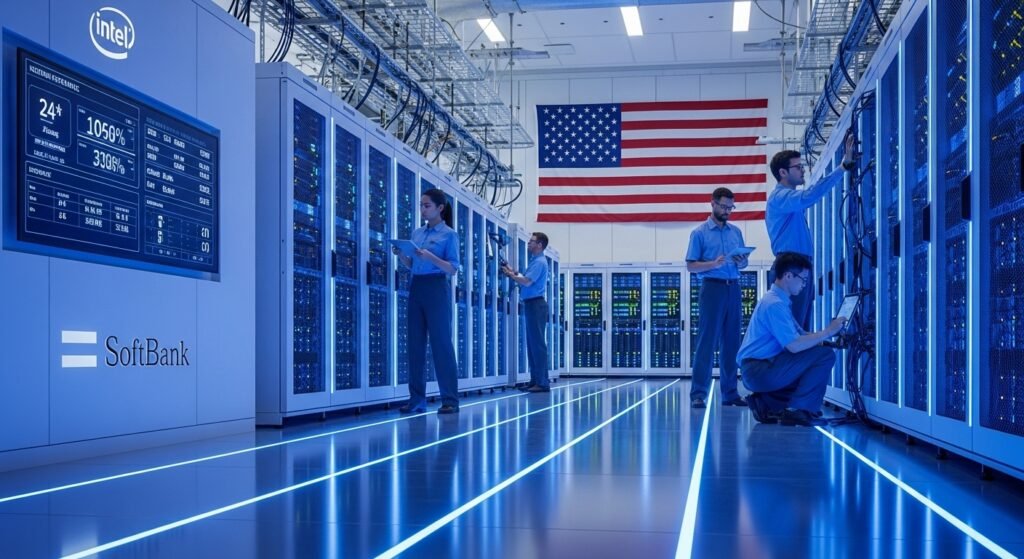
Amid investor unease, one story stands out as a vote of confidence in America’s AI future: SoftBank’s $2 billion equity investment in Intel.
- SoftBank purchased Intel shares at $23 each, taking a roughly 2% stake, which is enough to make them the company’s fifth-largest shareholder.
- The move immediately boosted Intel stock by 5–6% after-hours trading, starkly contrasting the broader market downturn.
- The investment aligns with the U.S. government’s interest in strengthening domestic chipmaking. Reports suggest Washington is considering a direct stake of up to 10% in Intel.
By betting on Intel, SoftBank is signaling that while AI valuations may be shaky, U.S. semiconductor infrastructure remains a solid long-term play. This aligns with America’s push to secure supply chains, protect national security, and ensure technological leadership in AI hardware.
The Policy Dimension: Why U.S. Leadership Matters
AI is not just a market story but a national policy and security matter.
- The Biden administration, along with ongoing bipartisan efforts, has emphasized reshoring semiconductor manufacturing.
- Investments in Intel and other U.S. chipmakers are part of a broader strategy to reduce dependence on foreign suppliers, particularly in Asia.
- With AI set to influence military, healthcare, finance, and education, ensuring a reliable U.S.-based infrastructure has become an economic and strategic imperative.
Thus, while investor anxiety is real, the long-term policy environment in the U.S. remains strongly supportive of AI infrastructure investments.
Looking Ahead: Storm or Stability?
The near future of U.S. markets will depend on several key events:
- Nvidia’s earnings report – As the poster child of the AI boom, Nvidia’s following results will either reassure investors or amplify bubble fears.
- Federal Reserve minutes – Any signal of interest rate changes will directly impact risk appetite for speculative assets, such as AI stocks.
- Jackson Hole Symposium – Central bankers and policymakers will discuss how disruptive technologies, such as AI, impact inflation, productivity, and economic growth.
For U.S. investors, the message is clear: AI is here to stay, but the road will be volatile. The challenge is separating short-term hype from long-term structural value.
Conclusion: America Balances Risk and Reward
The United States finds itself at the intersection of AI hype and economic reality. On the one hand, AI bubble warnings from Sam Altman, Nasdaq’s decline, and Wall Street sell-offs highlight the risks of overvaluation. On the other hand, SoftBank’s $2 billion investment in Intel’s U.S. AI infrastructure demonstrates its long-term faith in America’s role as a global technology leader.
For readers, policymakers, and investors alike, the lesson is not to abandon AI, but to approach it with cautious optimism, grounded expectations, and a focus on fundamentals. The coming months will test whether America’s AI economy is experiencing a temporary correction or whether this is the first sign of a deeper market restructuring.
Explore the Nvidia B30A AI chip and its role in the U.S.-China AI rivalry here
FAQs
Q1. What does “AI bubble warning Sam Altman” really mean for U.S. investors?
Answer: When people search this in the U.S., they want to know why OpenAI CEO Sam Altman is cautioning about a potential AI bubble. His statement suggested that current investor enthusiasm around AI may be unsustainable, much like past speculative tech booms. A MIT study further amplified concerns, showing that 95% of generative AI pilots deliver no measurable returns. For U.S. investors, this warning served as a red flag, prompting them to reconsider their long-term expectations.
Q2. Why is the headline “Nasdaq slides AI jitters” important for the U.S. market?
Answer: This phrase highlights how AI overvaluation fears are shaking investor confidence. On Wall Street, the Nasdaq Composite dropped by around 1.4%, fueled by concerns that AI-driven stocks, such as Nvidia, Palantir, and Arm, may be overhyped. For U.S. investors, such headlines mark a shift from early excitement to cautious evaluation of AI’s true market value.
Q3. What does the “Wall Street AI sell-off today” signal?
Answer: When U.S. investors see this phrase, it usually means a short-term market correction is happening in response to AI hype. On August 20, 2025, both the Nasdaq and the S&P 500 fell, despite the Dow Jones hitting an intraday high. This suggests that selective selling investors were pulling back from AI-related stocks while keeping faith in other sectors.
Q4. Why is the SoftBank-Intel investment a big deal for U.S. AI infrastructure?
Answer: The SoftBank $2 billion equity investment in Intel shows strong confidence in America’s AI chipmaking capacity. With Washington also considering support, this move strengthens the U.S. AI supply chain and reduces the country’s dependence on foreign technology. For investors, this signals long-term growth in AI infrastructure, a backbone for the next phase of artificial intelligence.
5. Is the AI bubble in the U.S. really like the dot-com crash?
Answer: This question pops up often: “AI bubble vs dot-com.” Many analysts see similarities in skyrocketing valuations, hype cycles, and market concentration among the “Magnificent Seven” tech giants. However, some firms like Goldman Sachs argue that today’s AI growth is backed by stronger profitability and enterprise adoption compared to 2000. While a correction may come, experts believe the AI sector has more real-world utility than the dot-com era did.
Q6. What did the MIT study reveal about AI returns in the U.S.?
Answer: The MIT “GenAI Divide” study revealed that 95% of enterprise AI projects fail to show real ROI. For U.S. businesses, this was a reality check: while the hype surrounding generative AI is massive, its practical execution remains limited. Investors took this as a sign to remain cautious, focusing on proven AI applications rather than speculative projects.
Q7. Who in the U.S. is warning that the AI bubble could be “bigger than the dot-com crash”?
Answer: Professor Erik Gordon of the University of Michigan has been one of the strongest voices warning about AI’s risks. He argues that an AI market bust could be more damaging than the dot-com crash because today’s AI investments involve pension funds, retirement savings, and broader financial exposure. A recent example is CoreWeave, an Nvidia-backed AI firm, which lost $24 billion in valuation in just two days.
Q8. How can U.S. investors protect themselves from an AI bubble?
Answer: The best strategy, according to Mercer Advisors and financial experts, is diversification. Don’t put all your money into AI stocks. Instead, balance your portfolio with other strong-performing sectors. Former Google CEO Eric Schmidt even acknowledged the risk of overcapacity in AI, but emphasized that the technology represents a long-term industrial shift, not just a passing fad. For U.S. investors, the key is cautious optimism backed by fundamentals.
The recent Meta AI guidelines leak has revealed worrying details about content moderation and data protection. Here’s a detailed breakdown you should definitely read.