Summary:
AGI: Super Intelligence marks the next technological frontier. A leap beyond narrow AI into the realm of true Super Intelligence. This article dives deep into what AGI is, how it works, its global impact, ethical challenges, and the futuristic implications shaping industries in the USA and Canada. From healthcare to creativity, AGI could forever redefine human potential and the digital economy.
Introduction:
Artificial General Intelligence (AGI) is no longer a distant dream; it represents humanity’s most ambitious step toward creating machines that think, reason, and evolve beyond programmed limits.
Unlike traditional AI models confined to single tasks, AGI is envisioned as a universal cognitive system capable of abstract reasoning, emotional understanding, and continuous learning. But as we edge closer to AGI’s realisation, experts ask: Is humanity ready for Super Intelligence?
This article explores AGI’s meaning, potential, risks, and how it may redefine life, work, and the global economy forever.
What Is AGI (Artificial General Intelligence)?

Artificial General Intelligence (AGI) refers to a form of AI capable of understanding, learning, and applying knowledge across a wide range of tasks just like humans. Unlike narrow AI, which focuses on specific functions (like Chatbots or image recognition), AGI possesses universal cognitive ability.
Key Characteristics of AGI:
- Human-like reasoning – can think abstractly and solve unfamiliar problems.
- Adaptive learning – Evolves continuously without retraining.
- Autonomous decision-making – acts based on logic, ethics, and goals.
- Continuous improvement – self-optimises its algorithms and neural networks.
TypeCapabilityExample
| Narrow AI | Task-specific intelligence | ChatGPT, Google Bard |
| AGI | Human-level understanding | Future reasoning-based LLMs |
| ASI | Beyond human cognition | Hypothetical Superintelligence |
Why AGI Is Called “Super Intelligence”
AGI is often called Super Intelligence because it could outperform human intelligence across every field, from scientific discovery to emotional creativity. It’s not about mimicking us; it’s about surpassing our limits.
AGI’s Super Intelligence Capabilities:
- Solves complex, global-scale problems beyond human comprehension.
- Learns how to learn (meta-learning).
- Generates new scientific theories and languages autonomously.
- Predicts large-scale systems from climate models to stock markets with unmatched accuracy.
In essence:
“AGI isn’t built to replace humans, it’s built to reflect the best version of human intelligence.”
How AGI Works: The Core Mechanism
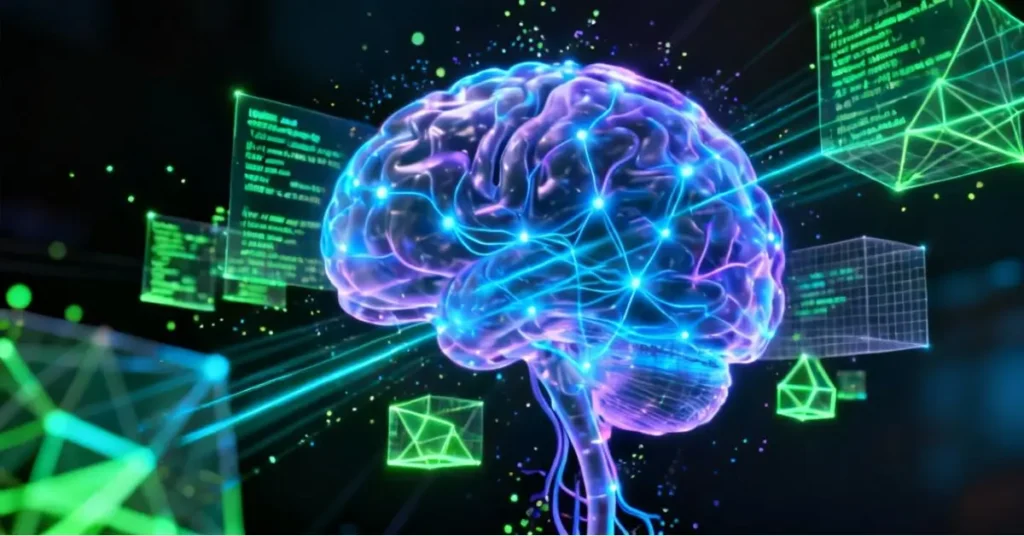
To understand AGI, let’s look under the hood into the cognitive, architectural, and self-learning mechanisms driving it.
1. Cognitive Framework
AGI simulates the human neocortex, integrating neural networks with symbolic reasoning. This allows the system to:
- Learn abstract concepts
- Understand contextual nuances
- Apply logic across different problem sets
2. Self-Evolution Loop
AGI can rewrite its own code, a process known as recursive self-improvement. Every iteration enhances its intelligence, enabling exponential growth in reasoning power.
3. Multi-Modal Learning
Unlike traditional AI, AGI learns from multiple sensory inputs simultaneously:
- Text
- Images
- Audio
- Emotions
- Actions
This fusion allows AGI to interpret the world like humans do through experience and association.
4. Goal-Oriented Behavior
Instead of pre-set tasks, AGI operates via goal functions and self-defined objectives based on logic, creativity, or ethics.
Benefits of AGI (Super Intelligence)
If developed responsibly, AGI could become humanity’s most powerful ally in shaping a better future.
Here’s what it can unlock:
1. Economic Transformation
- Automates complex industries (finance, law, medicine).
- Reduces human error and operational costs.
- Creates new AI-driven economies worth trillions globally.
2. Medical Revolution
- Accelerates drug discovery via quantum simulations.
- Predicts diseases using genome-level analysis.
- Enables personalised healthcare through adaptive diagnosis.
3. Climate & Energy Optimisation
- Simulates planetary ecosystems to reduce emissions.
- Designs efficient renewable systems autonomously.
4. Creativity & Art
- Generates new forms of art, music, and architecture.
- Collaborates with humans to create hybrid creativity.
The impact of AGI on creativity and communication is already visible in the media world. For instance, USA Today recently introduced an AI-powered Taboola chatbot that’s redefining how digital journalism interacts with readers, a glimpse of AGI’s early potential in storytelling.
Read the full story: DeeperDive: How USA Today’s New AI Chatbot is Redefining Journalism in 2025
AGI vs AI: Key Comparison Table
| Feature | Narrow AI | AGI | ASI (Super Intelligence) |
|---|---|---|---|
| Intelligence Scope | Specific | Universal | Infinite |
| Learning Method | Supervised | Self-learning | Self-improving |
| Adaptation | Limited | Unlimited | Autonomous |
| Creativity | Predictive | Original | Beyond Human |
| Decision Autonomy | Rule-based | Contextual | Fully independent |
Real-World Progress Toward AGI (2025 Insights)
The race toward AGI is global and intensifying rapidly. Let’s look at key organisations and milestones defining this journey.
Leading AGI Research Projects
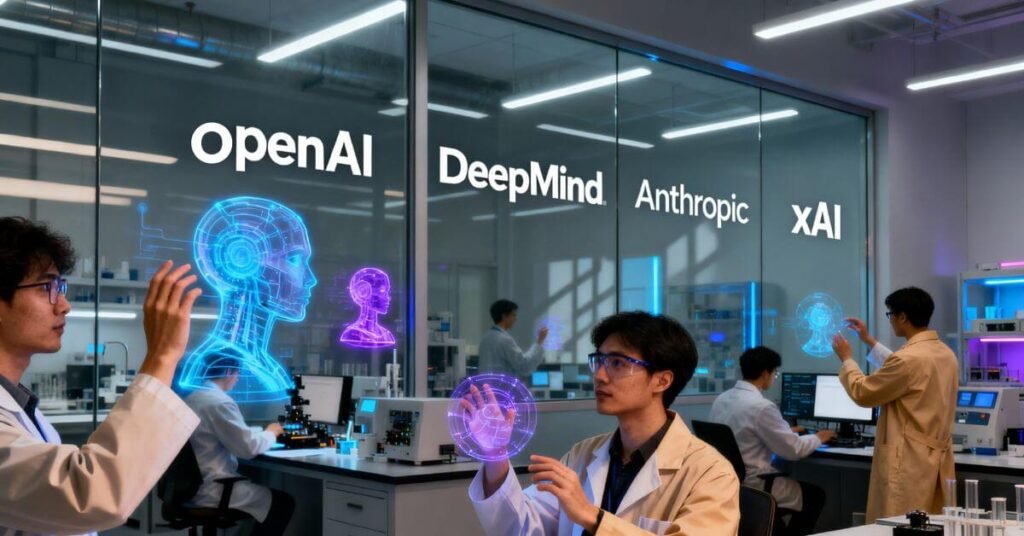
| Organization | Project | Objective |
|---|---|---|
| OpenAI | GPT & o1 Models | Reasoning-based AGI development |
| Anthropic | Claude | Alignment and AI safety |
| DeepMind | Gemini | Cognitive multi-modal AGI |
| xAI (Elon Musk) | Grok | Truth-seeking AI for real-world reasoning |
| Meta AI | LLaMA | Open-source AGI collaboration |
As AGI research accelerates in 2025, even foundational systems like operating environments are evolving to support advanced AI computation. With Microsoft officially ending support for Windows 10, the shift toward AI-optimized operating systems is reshaping global technology infrastructure.
Read more in our deep analysis:
Windows 10 End of Support 2025: The Dangerous Truth Microsoft Doesn’t Want You to Ignore
Recent Milestones (2024–2025)
- Launch of Agentic AI Systems‘ autonomous reasoning AIs.
- OpenAI’s o1 Model achieves near-human logic benchmarks.
- Robotics Integration: Projects like Figure 02 and Tesla Optimus merge AGI with humanoid design.
Ethical Concerns and Risks of AGI
Every revolution brings challenges, and AGI is no exception. Experts warn of potential risks if AGI is deployed without alignment.
Major Concerns
- Job Displacement: Automation across industries.
- Bias Amplification: Learned from flawed human data.
- Control Problem: Ensuring AGI remains aligned with human values.
- Existential Risk: Misaligned AGI acting against humanity.
Proposed Solutions
- Dedicated AI Safety Labs (Anthropic, DeepMind, OpenAI).
- Global regulatory frameworks (e.g., Canada’s AI and Data Act).
- Human-in-the-loop governance models for oversight.
Future of AGI: What Lies Ahead
AGI could mark the next evolutionary jump, merging biology with digital intelligence.
By 2030, experts predict partial AGI deployment in:
- Healthcare diagnosis
- Autonomous scientific research
- AI-driven governance models
Some futurists even believe AGI could coexist symbiotically with humans, amplifying our intelligence instead of replacing it.
“The first AGI will be humanity’s mirror it will reflect not our fears, but our collective intelligence.”
XetechAI Tech Analyst.
Conclusion: The Era of Super Intelligence Has Begun
AGI isn’t science fiction anymore; it’s the dawn of Super Intelligence, reshaping everything from jobs to philosophy.
If nurtured ethically, it could unlock limitless human potential. But if mishandled, AGI could redefine civilisation’s trajectory for better or worse.
The real question isn’t “Can we build AGI?” or “Can we control what comes after?”
FAQ about AGI: Super Intelligence
Q1. What is AGI (Artificial General Intelligence)?
Answer: AGI (Artificial General Intelligence) is a type of AI that can understand, learn, and perform any intellectual task that a human can do. Unlike narrow AI (which is task-specific), AGI can think abstractly, reason logically, and adapt across multiple domains.
Q2. How is AGI different from AI?
Answer: Traditional AI focuses on narrow tasks (like chatbots or image recognition). At the same time, AGI aims for true intelligence; it can solve unseen problems, reason independently, and improve itself without constant human input.
Q3. Why is AGI called “Super Intelligence”?
Answer: AGI earns the title of superintelligence because it’s expected to surpass human cognitive abilities, performing analysis, creativity, and decision-making faster and more accurately than humans.
Q4. Who is leading AGI development in 2025?
Answer: Major leaders include:
- OpenAI (GPT-5 & beyond)
- DeepMind (Gemini & AlphaCode)
- Anthropic (Claude)
- xAI (Elon Musk)
- Google Brain (merged with DeepMind)
Q5. How close are we to achieving real AGI?
Answer: Experts predict early AGI prototypes between 2027 and 2030, though full-scale AGI (autonomous, self-aware systems) might take longer. We already see early signs in multi-modal models like GPT-5, Gemini 2.5, and Claude 3.5.
Q6. Can AGI replace human jobs completely?
Answer: Not completely, but AGI will transform industries. Routine, repetitive, and analytical tasks will be automated, while creative and strategic human roles will evolve to supervise and collaborate with AGI systems.
Q7. What are the benefits of AGI?
Answer:
- Accelerated innovation in medicine, robotics, and energy
- Enhanced decision-making across industries
- Discovery of new scientific theories
- Reduction in human error and bias
Q8. What are the biggest risks of AGI?
Answer:
- Ethical misuse (autonomous weapons, surveillance)
- Economic inequality
- Loss of control if AGI becomes self-improving
- Misinformation on a massive scale
Q9. How can AGI affect humanity’s future?
Answer: AGI can reshape civilisation from post-scarcity economies to self-governing AI ecosystems. However, it also requires strict alignment with human values to prevent existential threats.
Q10. Is AGI conscious or self-aware?
Answer: As of 2025, no AI model possesses true consciousness. Though debate continues among neuroscientists and AI theorists, AGI systems simulate understanding through computation, not emotions or subjective awareness.
Q11. Will AGI have emotions like humans?
Answer: Not real emotions, but it can mimic emotional responses to improve interactions. Emotional simulation helps AGI communicate empathetically without genuine feelings.
Q12. How will AGI impact education and research?
Answer: AGI can personalise learning, generate original research, and even co-author scientific papers. It’s expected to become a co-pilot for discovery across all academic disciplines.
Q13. Is AGI dangerous for privacy and data security?
Answer: Yes, if unregulated. AGI’s ability to analyse and predict behaviours can lead to extreme surveillance or manipulation. Global AI governance frameworks are being discussed to control this.
Q14. Can AGI exist without internet connectivity?
Answer: Most AGI systems need networked environments for data access and model training. However, edge AGI systems (localised intelligence) are being explored for privacy and autonomy.
Q15. What programming languages are used to build AGI?
Answer: Python, C++, Julia, and Rust are common. Frameworks like PyTorch, TensorFlow, and LangChain help in AGI model design, reasoning, and integration.
Q16. What ethical frameworks are needed for AGI?
Answer:
- Transparency & Accountability
- Human Oversight
- Data Privacy Protection
- Bias Mitigation
- Explainability Standards
The USA, Canada, and EU governments are drafting policies to manage AGI safety.
Q17. What is the ultimate goal of AGI?
Answer: The ultimate goal is to create a universal problem-solver, an intelligence that helps humanity cure diseases, reverse climate change, and explore the cosmos, without replacing or endangering us.