Introduction
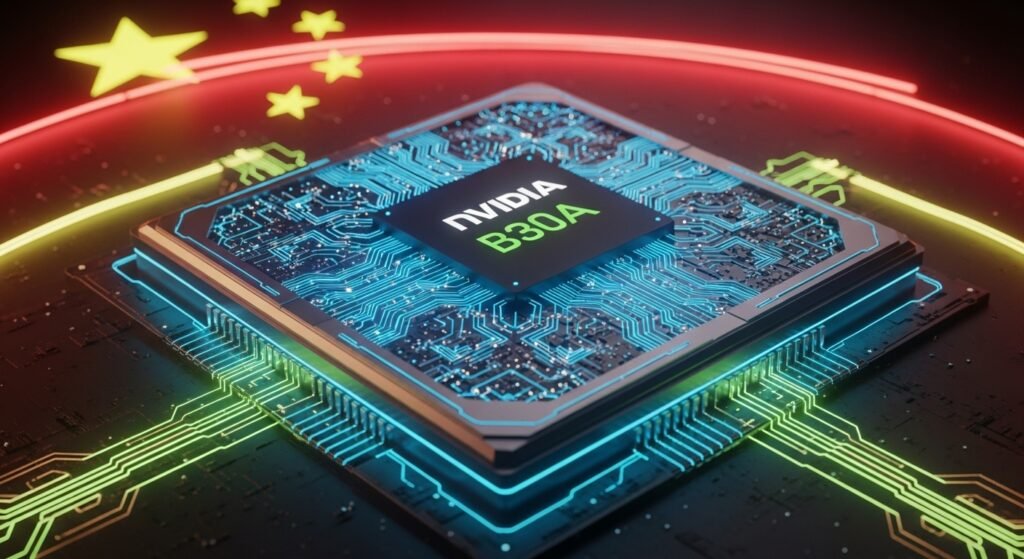
Nvidia, a global leader in AI and semiconductor technology, is reportedly developing a new AI chip explicitly tailored for China, tentatively named the B30A. This chip is designed to outperform Nvidia’s current H20 model, which is the most advanced AI chip currently permitted for sale in China under U.S. export regulations.
The development of B30A marks a strategic milestone in the U.S.-China technological rivalry, highlighting both the growing demand for advanced AI solutions in China and Nvidia’s intent to maintain a strong foothold in one of the largest AI markets globally.
As AI adoption accelerates across sectors, including Generative AI, Agentic AI, and Robotics, the introduction of the B30A is expected to reshape the AI landscape.
Background: H20 Chip and U.S. Export Restrictions
The H20 chip, Nvidia’s previous AI offering for China, was introduced to comply with U.S. export controls imposed in 2023. These restrictions aimed to limit China’s access to cutting-edge AI technologies that could potentially enhance military and strategic capabilities.
Initially, the H20 faced several challenges, including its high price point and competition from domestic alternatives. Despite these hurdles, Nvidia has reportedly achieved impressive adoption, with estimates suggesting over 1 million H20 units may be sold in China this year, generating revenue upwards of $12 billion.
However, as China’s AI ambitions expand rapidly, the H20’s performance is increasingly considered insufficient for high-end AI tasks, driving Nvidia to develop a more powerful solution. The B30A is expected to fill this gap, delivering enhanced capabilities for AI training, data processing, and robotics applications.
B30A: Technical Deep Dive

The B30A AI chip is based on Nvidia’s latest Blackwell architecture, substantially improving processing power, energy efficiency, and scalability. Unlike the dual-die B300 processor, the B30A uses a single-die design, achieving approximately 50% of the raw computational power of the B300 while remaining compliant with export restrictions.
Key technical features include:
- High-Bandwidth Memory (HBM3e): Ensures faster data transfer rates essential for large-scale AI training.
- NVLink Support: High-speed interconnect to support multi-GPU configurations for AI supercomputing.
- Enhanced AI Workload Optimization: The chip is fine-tuned for both generative AI models, like large language models, and agentic AI agents that perform autonomous decision-making.
- Energy Efficiency Improvements: The Blackwell architecture improves performance-per-watt, reducing operational costs for AI research centres.
The B30A is engineered to meet the growing demands of AI-driven industries in China, including autonomous vehicles, robotics, and cloud-based AI services.
Strategic Importance for Nvidia
China represents a critical market for Nvidia, accounting for an estimated 13% of global revenue. Maintaining access to this market is essential, particularly as domestic competitors like Huawei, Alibaba, and Inspur continue to advance in AI chip design.
The B30A helps Nvidia:
- Retain market leadership: Preventing Chinese customers from shifting to domestic alternatives.
- Expand software ecosystem: Nvidia’s AI software stack, including CUDA and AI frameworks, remains a key differentiator.
- Ensure long-term revenue: With AI adoption skyrocketing, cutting-edge hardware ensures repeat purchases and cloud deployment contracts.
At the same time, deploying the B30A poses national security considerations, as it could enable the development of more advanced AI supercomputers in China, potentially narrowing the technological gap with the U.S.
Geopolitical Implications
The development of the B30A underscores the complex interplay between technology, economics, and geopolitics. U.S. export restrictions have limited China’s access to the most advanced AI chips. Still, Nvidia’s strategy of offering a slightly less powerful yet highly capable chip ensures continued business while adhering to regulations.
China’s push for self-reliance in AI and semiconductors has intensified with domestic initiatives like Huawei’s 910C chip. The B30A could intensify the U.S.-China AI rivalry, influencing future AI standards, research capabilities, and even geopolitical strategy.
Moreover, access to the B30A allows China to maintain competitiveness in emerging technologies such as:
- Generative AI: Creating human-like content, including text, code, and media.
- Agentic AI: Autonomous systems capable of decision-making without constant human oversight.
- Robotics and Automation: AI-driven industrial and consumer robotics, transforming manufacturing and services.
These capabilities could shift the balance of technological power globally, affecting industries from healthcare to defence.
Impact on the Global AI Industry
The B30A’s introduction will also have ripple effects across the global AI ecosystem. By offering enhanced AI processing capabilities, the chip is likely to accelerate AI research in China, boosting innovation in:
- Large-scale language models (LLMs) and AI agents
- High-performance computing clusters for scientific research
- Cloud AI services for enterprises and startups
Additionally, Nvidia’s presence ensures a software-hardware ecosystem advantage, making it challenging for domestic chips to replicate the same performance and developer adoption in the short term.
From a global perspective, the B30A may influence AI hardware pricing, chip availability, and AI research competitiveness, encouraging both innovation and strategic caution among AI companies and governments worldwide.
Conclusion
Nvidia’s B30A AI chip represents a strategic, technical, and geopolitical milestone. By outperforming the H20 while remaining export-compliant, Nvidia balances market demands, technological leadership, and international regulations.
The B30A strengthens Nvidia’s position in China and exemplifies the broader U.S.-China AI rivalry, where every technological advancement carries economic, industrial, and security implications.
As generative AI, agentic AI, and robotics continue to expand globally, the introduction of the B30A is set to shape the future of AI innovation, influence global markets, and redefine competitive dynamics in semiconductor technology.
For AI enthusiasts, investors, and tech strategists, the B30A is more than just a chip; it symbolizes the evolving AI race and global technological power play.
For those interested in experimenting with AI models, you can also explore ChatGPT-5 and other advanced AI models for free to see how generative AI can complement hardware like the Nvidia B30A.”
Frequently Asked Questions (FAQs)
1. What is the Nvidia B30A AI chip?
Answer: The Nvidia B30A is a new AI chip designed explicitly for the Chinese market. It is based on Nvidia’s Blackwell architecture and is more powerful than the H20 model, while complying with U.S. export regulations. It targets advanced AI workloads, including generative AI, agentic AI, and robotics.
2. Why is the B30A considered better than the H20?
Answer: The B30A uses a single-die design, making it more efficient than the H20’s multi-die configuration. It also features high-bandwidth memory (HBM3e) and NVLink technology, which are essential for large-scale AI training and high-performance computing tasks.
3. How does B30A’s performance compare to the flagship B300 chip?
Answer: B30A achieves approximately 50% of the raw computational power of the B300. It is optimized to meet export compliance while still providing advanced AI processing capabilities for the Chinese market.
4. What impact will B30A have on China’s AI market?
Answer: B30A is expected to boost China’s AI-driven industries such as autonomous vehicles, robotics, and cloud-based AI services. It helps Nvidia maintain its competitive edge against local companies like Huawei, Alibaba, and Inspur.
5. Why is it essential for Nvidia to maintain its market share in China?
Answer: China accounts for roughly 13% of Nvidia’s global revenue. Retaining market leadership ensures Nvidia’s software ecosystem (CUDA, AI frameworks) remains dominant and supports long-term revenue from hardware sales and cloud deployments.
6. What role do U.S. export controls play in B30A’s development?
Answer: The B30A is designed to comply with U.S. export restrictions. Nvidia has reportedly agreed to give 15% of China-based AI chip revenue to the U.S. Treasury, marking a strategic approach to balancing compliance and market access.
7. How will B30A affect the global AI industry?
Answer: The introduction of B30A could influence AI hardware pricing, chip availability, and global research competitiveness. It will likely accelerate innovation while encouraging strategic caution among AI companies and governments worldwide.
8. What is B30A’s long-term potential?
Answer: The B30A represents a strategic, technical, and geopolitical milestone for Nvidia. It balances market demand, technological leadership, and international regulations, shaping the future of AI innovation and redefining the competitive dynamics in semiconductor technology globally.